What is a Communications Standard?
A communications standard is a connection method for transferring image data between a camera and a computer (image processing unit). As the number of pixels and frame rate increase, the amount of data that needs to be transferred also increases, so it is essential to select an appropriate communications standard.
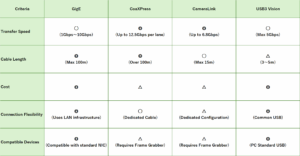
Features of the main Communications Standards
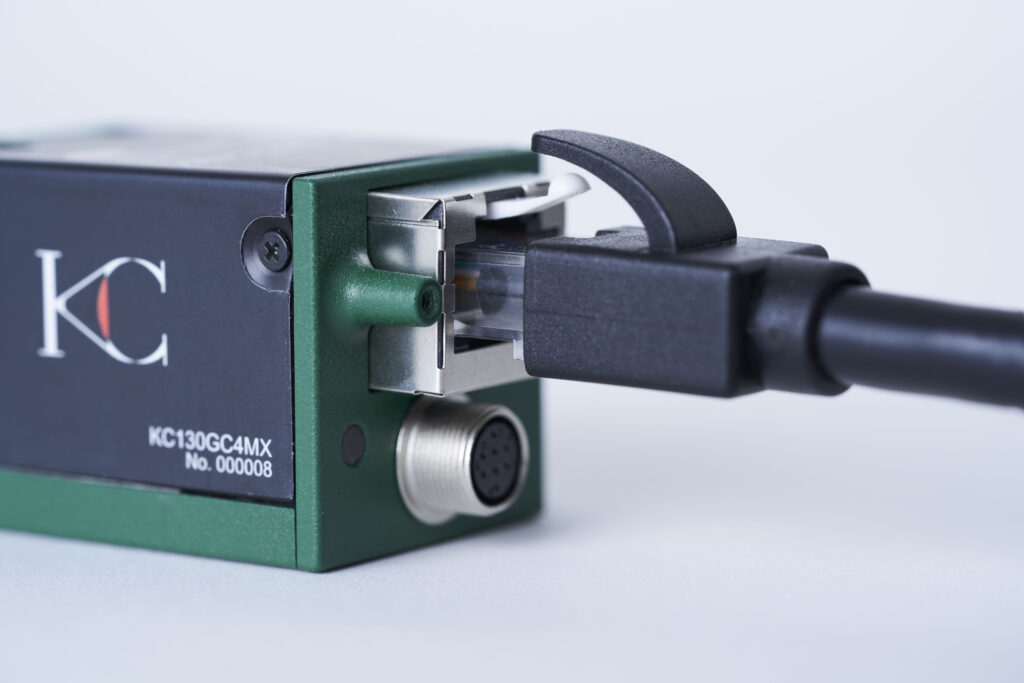
GigE(Gigabit Ethernet)
GigE is one of the communications standards widely adopted in industrial cameras.
Transfer speed
1Gbps (standard), 2.5Gbps/5Gbps/10Gbps (higher standards available)
Cable length
Up to 100m (when using a Cat5e or higher LAN cable)
Features
・Can utilize general network infrastructure
・Easy network connection of multiple cameras
・PoE (Power over Ethernet) compatible models are also available, simplifying wiring
Points to note
・High-speed models require the selection of compatible NICs and cables
・Network design for bandwidth control and packet loss prevention is important
GigE is a communications standard with excellent versatility and scalability, and its greatest appeal is its ability to flexibly change its configuration depending on the system scale and application.
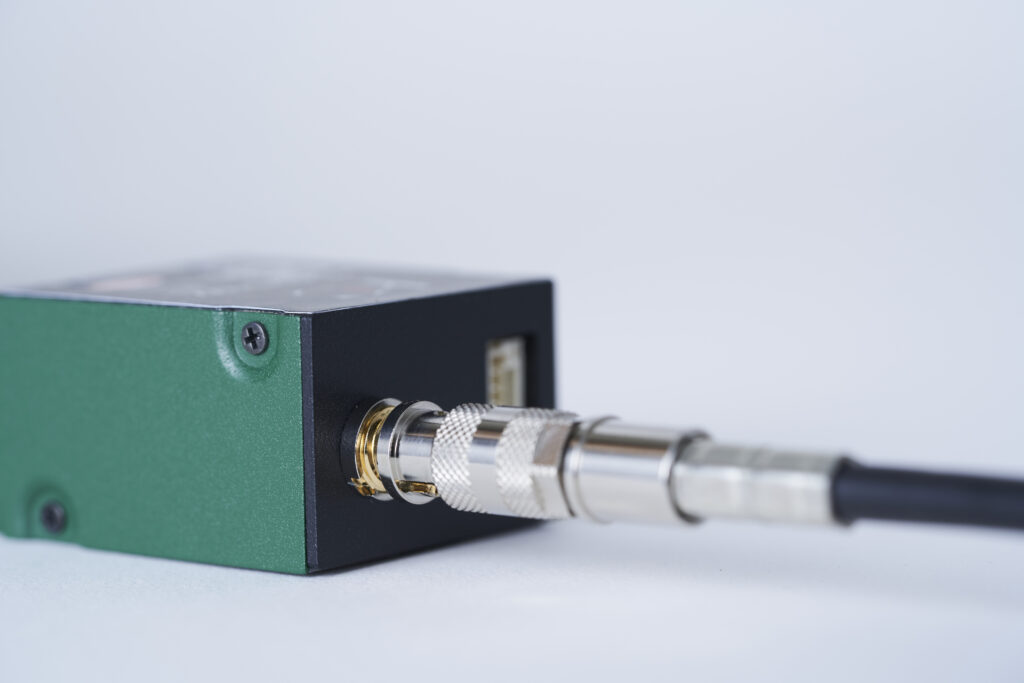
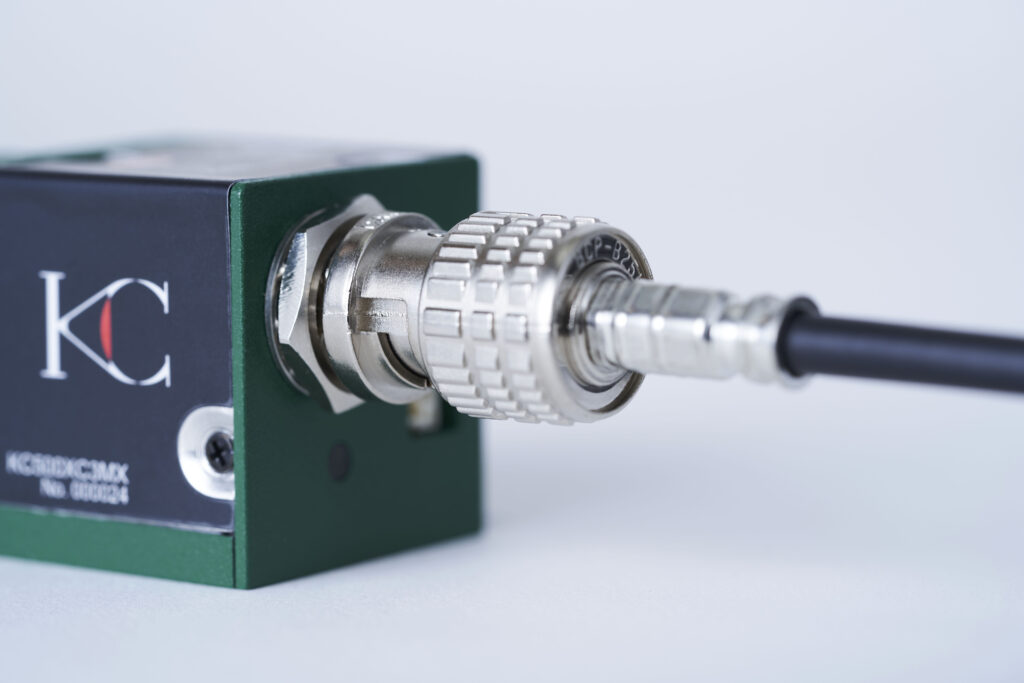
CoaXPress(CXP)
CoaXPress is a high-speed, highly reliable communications standard for industrial cameras, and its unique feature is that it can simultaneously transmit image data and control signals using a coaxial cable. There are multiple versions of the standard, and you can select the one that best suits your application.
Transfer speed
1.25Gbps (CXP-1) to 12.5Gbps (CXP-12) per lane
*Maximum speeds of 50Gbps or more are possible with multiple lane configurations
Cable length
Maximum 100m or more
Features
・High speed, long distance transmission possible
・With a single coaxial cable(PoCXP compatible), Power supply, Control, and Image transfer are possible.
・Supports real-time triggers and low-latency communication
・Ideal for cameras with high pixel count and high frame rate
Points to note
・A dedicated frame grabber is required
・Cables and connectors are specific to the standard, which can increase costs
・Signal integrity and noise countermeasures are important in system design
CoaXPress is an extremely effective option for inspection processes that require high precision and high speed processing, or for environments that require
long-distance wiring.
CameraLink
CameraLink is a highly reliable, high-speed communications standard designed for industrial cameras, and is widely used in fields where real-time image processing is required. It features Base, Medium, and Full configurations that allow flexible selection of transfer speeds and number of channels.
Transfer speed
Maximum 6.8Gbps (Full configuration)
*Varies depending on configuration, such as Base (2.04Gbps) or Medium (4.08Gbps)
Cable length
Maximum 15m (standard specification)
Features
・High-speed, highly reliable image transfer possible
・Strengths in real-time triggers and synchronous control
・Stable processing possible when combined with a frame grabber
・High compatibility with inspection equipment and measuring instruments
Points to note
・A dedicated frame grabber is required
・Cable length is limited, so consideration must be given to the installation environment
・Cable and connector handling requires ingenuity
CameraLink is the ideal communications standard for inspection processes that prioritize real-time performance and reliability, and for systems that require precise image synchronization. By selecting the configuration, you can flexibly design the system according to its scale and processing capacity.
USB3 Vision
USB3 Vision is a high-speed image transfer standard for industrial cameras, designed to utilize the USB 3.0 interface for stable transfer of high-resolution, high-frame-rate images. Standardized by the AIA (Automated Imaging Association),
Transfer speed
Maximum 5Gbps (USB 3.0 theoretical value)
*The actual speed is approximately 3.2Gbps (varies depending on the device and environment)
Cable length
Maximum 3-5m (USB 3.0 standard)
*Extension is possible using active cables or optical fibers.
Features
・High-bandwidth, low-cost image transfer possible
・Easy setup with plug-and-play support
・GenICam compliant for smooth integration with image processing software
・Power supply possible (communication + power supply with one USB cable)
Points to note
・Cable length is limited, so ingenuity is required for long-distance wiring
・Some high-performance cameras may experience insufficient bandwidth.
・Some parts depend on the quality of the USB port and the design of the PC.
USB3 Vision is ideal for systems that prioritize cost performance and ease of implementation. Its high compatibility with image processing software, especially for applications that process medium to high resolution images in real time, contributes to improving development efficiency.
Summary
Differences in communications standards have a significant impact not only on camera performance, but also on the design and operation of the entire system. Kowa Optronics offers a wide range of cameras equipped with the optimal communications standards for each application and environment, allowing us to offer flexible proposals tailored to the challenges faced on-site.